01 / Observe
Activity across channels.
Follow the highlighted samples from six interacting signals.
Neural dynamics · Epilepsy · Neuromodulation
My research asks where, when and how to stimulate neural circuits in epilepsy. I approach these questions with dynamical systems, modelling and reservoir computing for implantable devices.
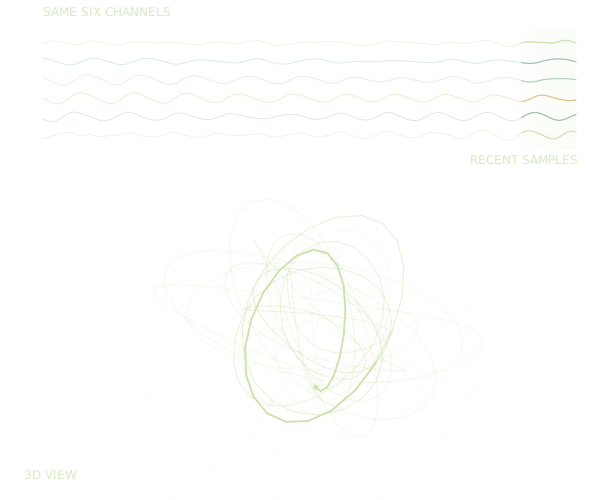
Six signals are generated by interacting oscillators. Follow a short window of activity into a different view of the same samples.
A brief input. Then the network responds.
A network of coupled Kuramoto phase oscillators generates six observed channels. Delayed samples from those channels form a higher-dimensional representation, shown here through a fixed three-dimensional principal-component projection.
The same observations drive the traces and the trajectory. A finite, phase-dependent input changes oscillator timing; coupling then governs the response. The projection and scale stay fixed throughout.
This is an illustration of phase coordination and perturbation, not an experimental recording or a model of treatment efficacy. The phase-only model does not describe an amplitude Hopf bifurcation.
16 oscillators · 6 observed channels · 4 delays per channel. Delays: 0, 0.133, 0.267, 0.400 model seconds. RK4 integration at 120 Hz; observations at 30 Hz. A 1.6-second input acts on four phase groups.
01 / Observe
Follow the highlighted samples from six interacting signals.
02 / Reconstruct
Recent history becomes coordinates. The same samples trace a path through a reconstructed space.
03 / Intervene
Apply a brief input, then follow the network's response under its original coupling.
01 / Three questions
Where, when and how to stimulate. Three connected questions for neuromodulation in epilepsy.
The map follows three questions about stimulation. Where is work in progress; When and How connect the papers and conference contributions below.
Where to stimulateWork in progress
An open research direction: using dynamical systems and models of neural activity to investigate stimulation targets. This work is in progress.
01 / 07When to stimulate
2025
PLOS ONE, 20(1), e0309550
Time-series segmentation methods identify epileptiform events in recordings from hippocampus-cortex slices.
02 / 07When to stimulate
2021 Conference paper
PACBB 2020, Advances in Intelligent Systems and Computing, 1240, 197–204
A mathematical algorithm detects interictal events in neural recordings, contributing to the analysis of epileptiform activity.
03 / 07When to stimulate
2024 Conference abstract
Journal of Computational Neuroscience, 52(Suppl. 1), S32–S33 · CNS*2023 abstract P29
An exploratory study of Transformer encoders for seizure-onset prediction from microelectrode-array recordings.
The DOI links to the CNS*2023 abstract collection; this contribution is P29, pages S32–S33.
04 / 07How to stimulate
2022
Biology, 11(3), 371
A study of stimulation patterns that mimic the temporal structure of hippocampal CA3 activity in vitro.
05 / 07How to stimulate
2023
Journal of Neural Engineering, 20(4), 046021
An artificial connection uses ongoing hippocampal activity to restore circuit communication in a brain-slice model.
06 / 07How to stimulate
2026
Brain Stimulation, 19(5), 103188
A compact reservoir model generates brain-inspired timing patterns for an open-loop study of cortical-network modulation in vitro.
07 / 07How to stimulate
2024 Conference abstract
Bernstein Conference 2024
Diffusion and Transformer models generate synthetic neural time series, with brain-inspired stimulation as a proposed application.
Shared topics guide this conceptual layout. Height and distance do not measure similarity.
View all selected publications02 / Selected papers
Ángel Canal-Alonso, Adam Armada-Moreira, Alessio Di Clemente, María Cerezo-Sánchez, Antonia Pavlidou, Danial Kiamarsi, Michele Giugliano, Hadi Heidari
Brain Stimulation, 19(5), 103188
A compact reservoir model generates brain-inspired timing patterns for an open-loop study of cortical-network modulation in vitro.
Gabriel Galeote-Checa, Gabriella Panuccio, Angel Canal-Alonso, Bernabe Linares-Barranco, Teresa Serrano-Gotarredona
PLOS ONE, 20(1), e0309550
Time-series segmentation methods identify epileptiform events in recordings from hippocampus-cortex slices.
Marco Hernández Pérez, Ángel Canal-Alonso, Guillermo Hernández, Sara Rodríguez, Angélica González, Fernando de la Prieta, Javier Prieto, Juan Manuel Corchado
Conference abstract · Journal of Computational Neuroscience, 52(Suppl. 1), S32–S33 · CNS*2023 abstract P29
An exploratory study of Transformer encoders for seizure-onset prediction from microelectrode-array recordings.
The DOI links to the CNS*2023 abstract collection; this contribution is P29, pages S32–S33.
Marco Zurdo-Tabernero, Pablo Enrique-Guillem, Ángel Canal-Alonso, Guillermo Hernández, Angélica González-Arrieta, Juan Manuel Corchado
Conference abstract · Bernstein Conference 2024
Diffusion and Transformer models generate synthetic neural time series, with brain-inspired stimulation as a proposed application.
Davide Caron, Stefano Buccelli, Angel Canal-Alonso, Javad Farsani, Giacomo Pruzzo, Bernabé Linares Barranco, Juan Manuel Corchado, Michela Chiappalone, Gabriella Panuccio
Journal of Neural Engineering, 20(4), 046021
An artificial connection uses ongoing hippocampal activity to restore circuit communication in a brain-slice model.
Ángel Canal-Alonso, Roberto Casado-Vara, Orlando Castellano, Jorge Herrera-Santos, Jaime Gonçalves, Sergio Màrquez-Sànchez, Jesús María Gonçalves, Juan Manuel Corchado
Philosophical Transactions of the Royal Society A, 380(2228), 20210010
Design and validation of a miniaturized, implantable vagus nerve stimulator for animal research.
Davide Caron, Ángel Canal-Alonso, Gabriella Panuccio
Biology, 11(3), 371
A study of stimulation patterns that mimic the temporal structure of hippocampal CA3 activity in vitro.
David García-Retuerta, Angel Canal-Alonso, Roberto Casado-Vara, Angel Martin-del Rey, Gabriella Panuccio, Juan M. Corchado
Conference paper · PACBB 2020, Advances in Intelligent Systems and Computing, 1240, 197–204
A mathematical algorithm detects interictal events in neural recordings, contributing to the analysis of epileptiform activity.
04 / A question I work on
How can the timing of neural activity inform stimulation for epilepsy?
I'm a postgraduate researcher in the Microelectronics Lab at the University of Glasgow. I use computational models to generate brain-inspired signals for neuromodulation, and study how their timing can inform stimulation for epilepsy.
My work connects computational models with in vitro experiments. I also work on bioactive, adaptive coatings for neural probes, looking at the materials between a device and living tissue.
05 / Contact